Buy a used book, get history

So I bought a copy of the Early English Text Society edition of The South English Legendary:  
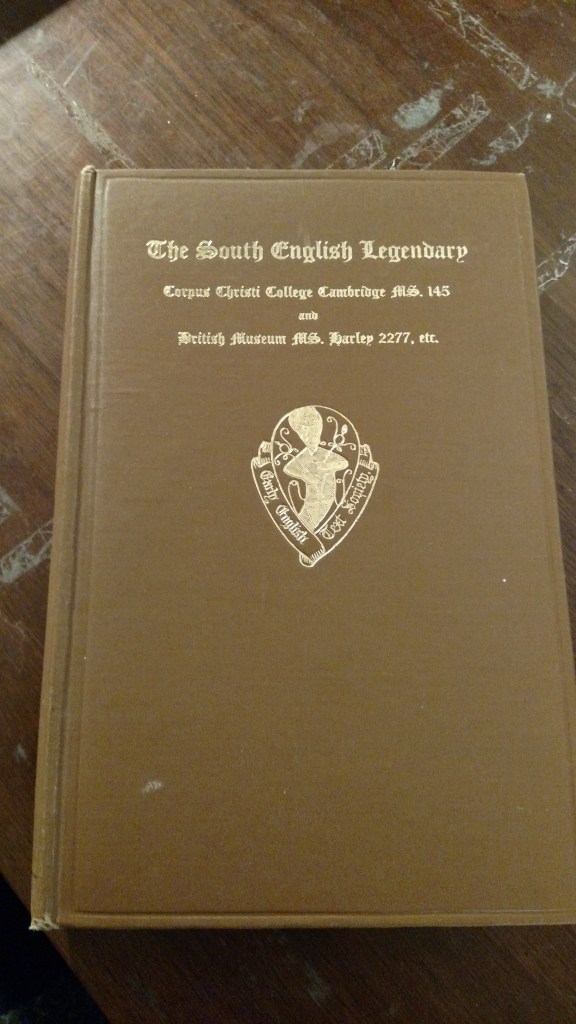
IMG_20160509_202620662(Ever notice how you feel smarter already when you buy a book that comes in multiple volumes, the last of which is exclusively notes and commentary?)

What is even cooler than the book(s) is that the set arrived with its own history tucked inside.  The inscription of the original owners:
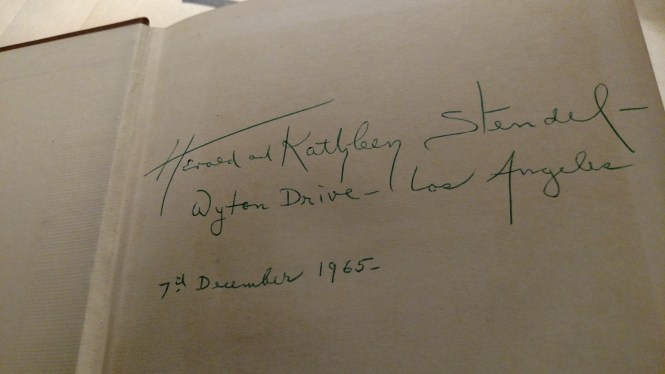
IMG_20160509_202643191

Okay, fine, I hear you, lot of books have their first (and sometimes subsequent) owners’ names written inside.  Tough crowd.

But then there was this:
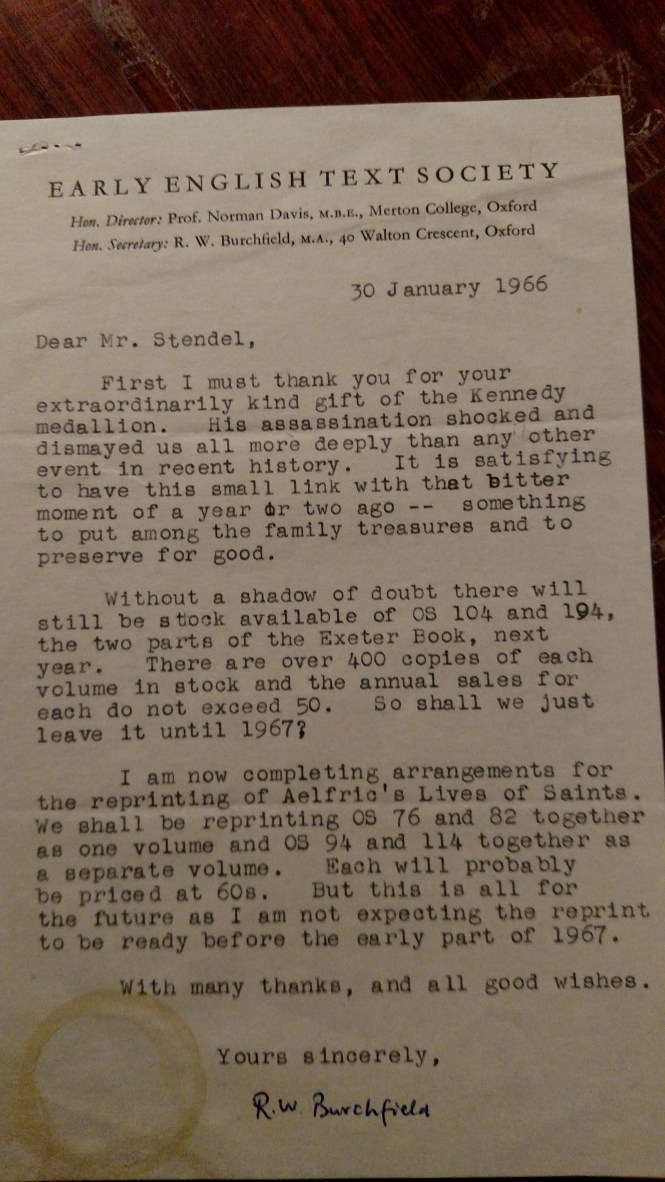
IMG_20160509_202636101

A letter from the EETS editor, to the original purchaser, and mentioning the Kennedy assassination.  Complete with coffee mug stains from either sender or receiver.

And then:
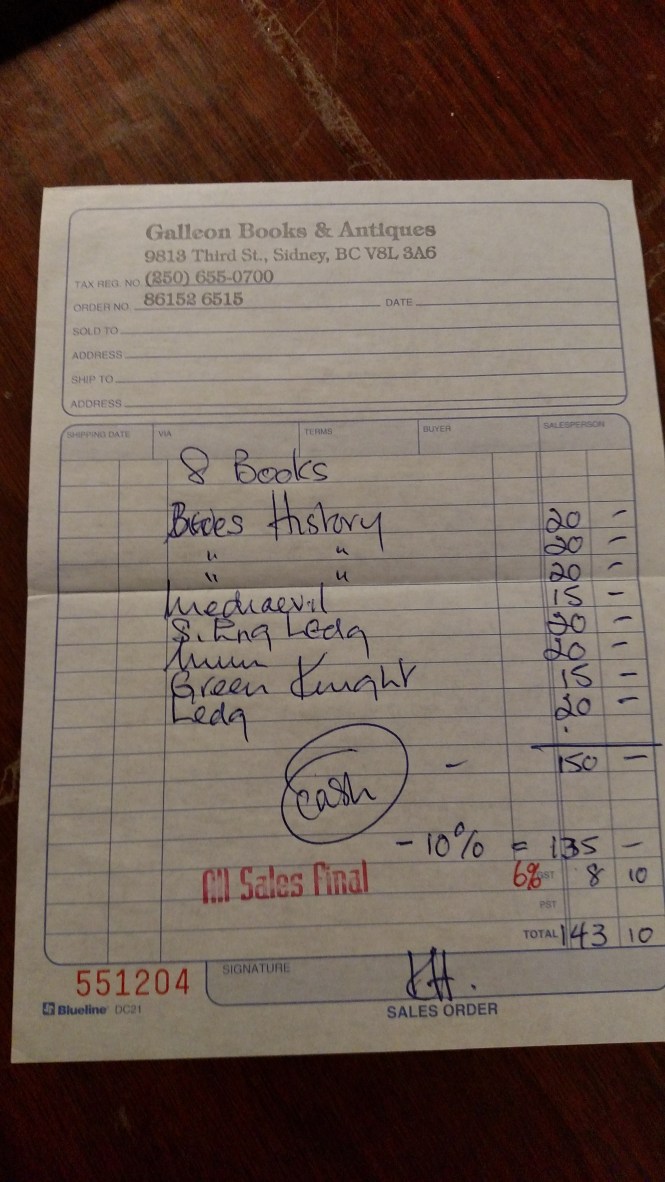
IMG_20160509_202651064 (1)The bill of sale from when the set was bought used, having somehow made its way to British Columbia from Los Angeles.

Not to mention the bill of sale I was actually expecting:  IMG_20160509_205340887
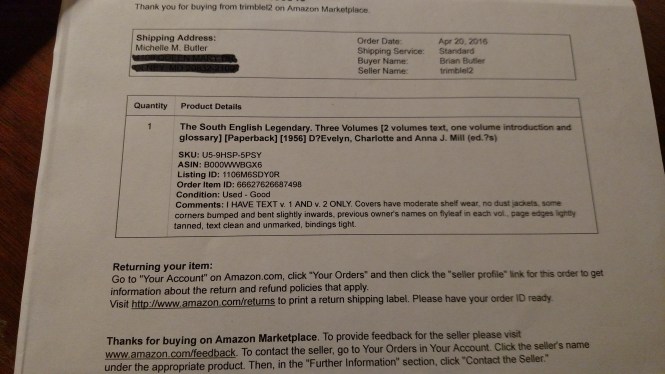
(Close-eyed observers will note that this set had misplaced volume 3, no doubt on the hard trek to British Columbia.  I ordered it separately.)

Either the owner(s) have an unusual commitment to history, keeping the sales receipts with the book(s), or this is a book that tends to be purchased more than read.

Weelll, it is a collection of edifying saints’ lives.  Make up your own minds.  Could go either way.


Bayeux Tapestry Replica

So this guy spent 10,000 hours and 18 years embroidering a smaller-version replica of the Bayeux Tapestry.  Holy smoke.

Another nifty item in Waterford

This knife is recent discovery.  I expect the interpretation of the inscription is accurate, but if I were using putting it in a story, I’d be tempted to have the ‘real’ meaning so more like, ‘when I kill you, I pray for your soul to go to heaven.’


Henry 8 is, Apparently, Naked in the Afterlife

Because only one piece of his clothing survives.  It’s in a museum in Waterford, Ireland.

Learning Old English

So you’re interested in learning some Old English but the textbooks look a bit dry?  New website to the rescue!

Battle of Hastings

I’m a tad late recognizing the 946th anniversary of the Battle of Hastings, which was of course October 14th.

Better late than never.

Everybody sing along now. Norman Invasion

Shakespeare’s Curtain Theater found!

This is quite exciting…archeologists have uncovered the remains of the Curtain Theater, where many of Shakespeare’s plays were performed.

The Other British Isles (David W. Moore)

This book is a quick read about a topic you (or at least me) thought you already knew something about–the smaller islands around England–but it turns out you’re wrong.  The prose is informative without being dense, always a plus.  My brain is still scarred from years of parsing academic articles.  If I never hear the word ‘praxis’ again, fine by me.  Anyway, this book.  Victor Hugo lived for years in exile on Jersey?  Who knew?  I was hoping for more information about Iona, since one of my current projects is set there but the book was fascinating nonetheless, particularly in regards to explaining how/why/how much the scattered islands do/do not consider themselves part of England.  Spoiler alert:  more no than yes.  The only real problem with the book is now I want to go see a whole bunch more places, all of which are relatively difficult to get to.

Fake Mermaid Mummy

Goodness sakes, real history is difficult enough to piece back together without the added confusion of intentional fakery. But humans being what we are, fakes exist.

This particular fake, supposedly a mummified mermaid, is mid-19th century in origin. But of course faux relics, etc., were being painstakingly (Shroud of Turin) or not-so-painstakingly (pig bones substituted for saints’ bones) by at least the 12th century.

It’s easy to guffaw, I suppose, about the gullibility of our forebears, who might have thought this proved mermaids existed. But of course this is the same time period in which dinosaur fossils are coming to light for the first time in significant numbers. If those beasties were real, why not this one? She sure looks real.

I find myself simultaneously appalled at the fakery and utterly impressed with the skill and ingenuity that went into creating it.

Anglo-Saxon Hoard Discovered in 2009 on Exhibit in U.S.

Medievalists around the world heard the spine-tingling news in 2009–the discovery of the largest Anglo-Saxon gold hoard ever found, the most important Anglo-Saxon hoard uncovered since Sutton Hoo. Now a selection of the pieces are on display in Washington D.C. at the National Geographic Museum.

http://events.nationalgeographic.com/events/exhibits/2011/10/29/anglo-saxon-hoard/